Editor’s Note: Overdraft Apps provides detailed product reviews and recommendations based upon extensive research and our own hands-on testing. We may earn a referral fee when you sign up for or purchase products mentioned in this article.

Mitchel holds a Bachelors of Business Administration in Finance from The Goizeta School of Business at Emory University and a Masters of Business Administration from The Haas School of Business at The University of California.
- Uprova Review: Tribal Loan Costs, Real APRs, and When to Avoid It - July 19, 2026
- Tribal Loans for Bad Credit: What They Actually Cost - July 15, 2026
- Upstart Cash Line Review: $200 Minimum Limit Guaranteed - June 25, 2026
30-SECOND SUMMARY: Uprova is a real tribal installment lender—not a scam—that funds $300–$5,000 fast for people with bad credit. The catch is cost: signed loan papers we’ve reviewed show APRs around 540%–690%, far above the 34.5% example on their site. Use it only for a true emergency, borrow small, and pay it off early.
Last updated: July 2026

If your credit is wrecked, you’ve probably said it out loud: “I’d take any loan I could get right now.” Before you mean that, listen to one story.
Last February a woman needed $1,200. Every bank said no. She found a lender called Uprova. About thirty minutes later the money was in her account. Her terms: 18 payments, twice a month, for about 9 months—$248.08 each time.
She paid back $4,465.44 total to borrow $1,200. The extra $3,265.44 was interest—about 477%.
Nobody tricked her. The rate was in the paperwork she signed. She just didn’t stop to do the math until the payments started hitting. (That story comes from a public BBB complaint filed against Uprova.)
Uprova is not a scam. It is a real lender that serves people many banks won’t touch. Terrible credit often doesn’t matter. Loans run $300 to $5,000. Funding can land in about 30 minutes—even late at night. Thousands of people call that a lifeline. For them, it is one.
So what will an Uprova loan really cost you? This Uprova review walks through the product, real signed disclosures, and when (if ever) it makes sense. For the bigger picture on this market, see our guide to tribal loans for bad credit.
Uprova at a glance
- What it is: A tribal installment loan from Uprova Credit, LLC (Habematolel Pomo of Upper Lake)
- Loan range: $300–$5,000, paid over about 9–36 months
- Speed: Decision in seconds; funds often within ~30 minutes, 24/7
- Advertised example APR: 34.5% for “highly qualified” borrowers on $500+ / 36 months
- Real signed examples we reviewed: about 540%–690% APR on $300–$1,000 loans
- Biggest risk: High interest + automatic bank pulls if you can’t keep up
What is Uprova? (And what is a tribal loan?)
Uprova is owned by a Native American tribe: the Habematolel Pomo of Upper Lake, in Lake County, California. The tribe’s name comes from an old Pomo phrase meaning “the people of rock village.” You can hear the modern pronunciation on the Native American Rights Fund tribe page.

A tribe is its own nation. It has a government to run and people to care for. To pay for that, tribes run businesses—just like the tribal casinos you’ve driven past. This tribe runs Running Creek Casino. Profits can fund housing, health care, elders, and language programs. Online lending is another business. The reservation is remote. The internet reaches everyone.
Almost every state caps how much interest a regular lender can charge. Tribal land is not covered by your state’s interest rules the same way. That is what a tribal loan is: a loan from a lender your state often can’t regulate like a storefront payday shop.
Is it legal? Yes. Is it fought over? Constantly. Borrowers in Virginia sued this tribe’s earlier lending business, saying the interest was illegal in their home states. That fight ended in a settlement worth about $489 million.
Give tribal loans this much credit: they beat classic payday loans in one way. A payday loan wants everything back in two weeks. Miss it, roll it over, pay another fee, and repeat. A tribal installment loan you chip away at over months, and it actually ends. Better product. Not a good one.
How does an Uprova loan work?
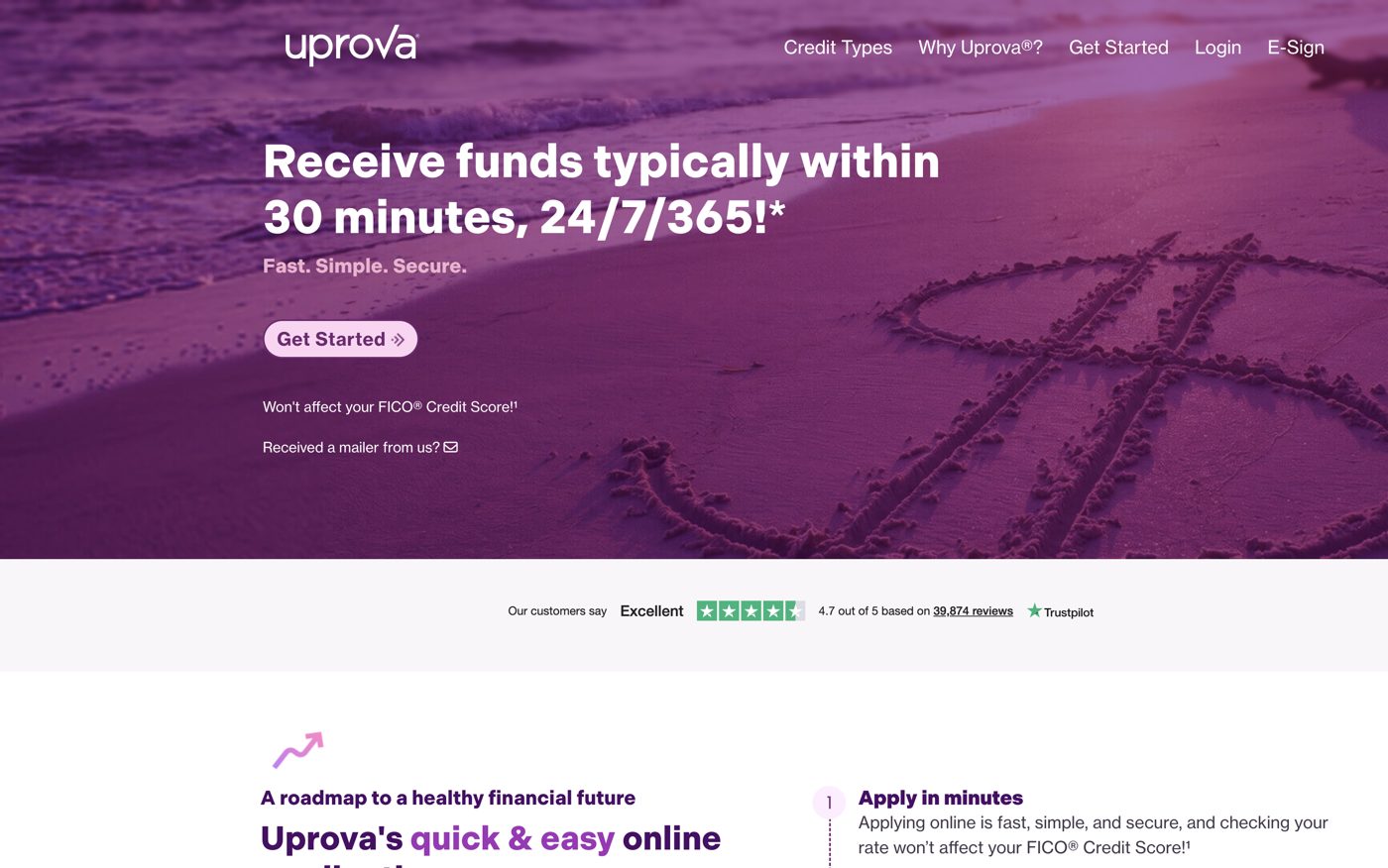
The product is simple, and it has real upsides.
- $300 to $5,000, paid back over about 9 to 36 months
- Decision in seconds; money often in about 30 minutes, any day, including weekends
- Customers often praise speed, a simple app flow, and humans on the phone
- Available in about 28 states—not places like New York, Pennsylvania, Illinois, Ohio, Georgia, or Virginia
To qualify you usually need to be 18, live in a state they serve, show income, and have a checking account. A bad score does not automatically disqualify you. Uprova openly works with poor or no credit. What they weigh more: your income, how steady it is, your other debts, how much you ask for, and your state.
They may pull your credit, but checking your rate is a soft pull. Soft means they peek and your score does not move. Hard means it can ding you a few points. So you can check Uprova and other lenders the same day without stacking hard inquiries.
Here’s the catch. Uprova does not clearly publish a full rate range on its website. You won’t know your real deal until you apply and get an offer. When your credit is low, a “yes” feels exciting. That is the moment to slow down, read the offer, and do the math.
What does an Uprova loan actually cost?
Start with Uprova’s own example on uprova.com.
Borrow $2,500 at 34.5% over 36 months. Pay $51.58 every two weeks. Total back: $4,023.53—about $1,523.53 in interest.
For bad credit, 34.5% is not shocking by itself. Many regular personal loan companies go near 36% for riskier borrowers. The problem: that’s the only clear rate they show. Most lenders publish a low-to-high range. Uprova gives this one example and stops.
Read the sentence above that example, almost word for word: for “highly qualified” customers who take $500 or more, the APR is 34.5% for 36 months. If you do not qualify for those terms, you may get a shorter loan at a higher APR. They never say how much higher.
Does anybody get 34.5%? Probably. Is it typical? We doubt it—because signed papers and borrower posts keep showing much higher numbers.
Real Uprova loan examples (including signed disclosures)
These next numbers are not guesses. Two come from Uprova’s own Truth in Lending disclosures—the paper you get before you sign.
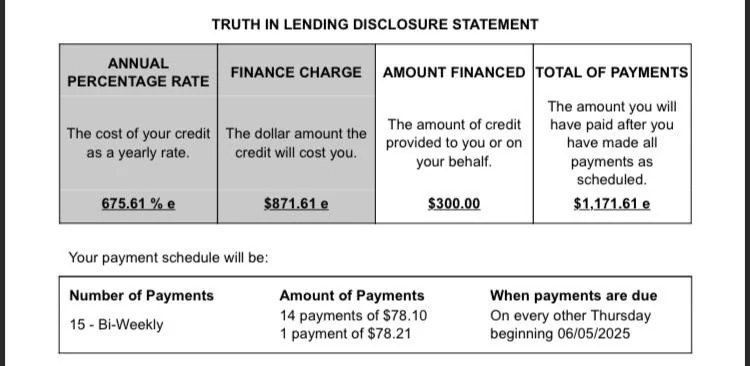
$300 loan (Uprova TILA disclosure): 15 biweekly payments of about $78. APR: 675.61%. Total back: $1,171.61 ($871.61 interest).
$500 loan (borrower post): 18 payments of $106.14 every two weeks. APR: 540.08%. Total back: $1,910.05 ($1,410.05 interest).
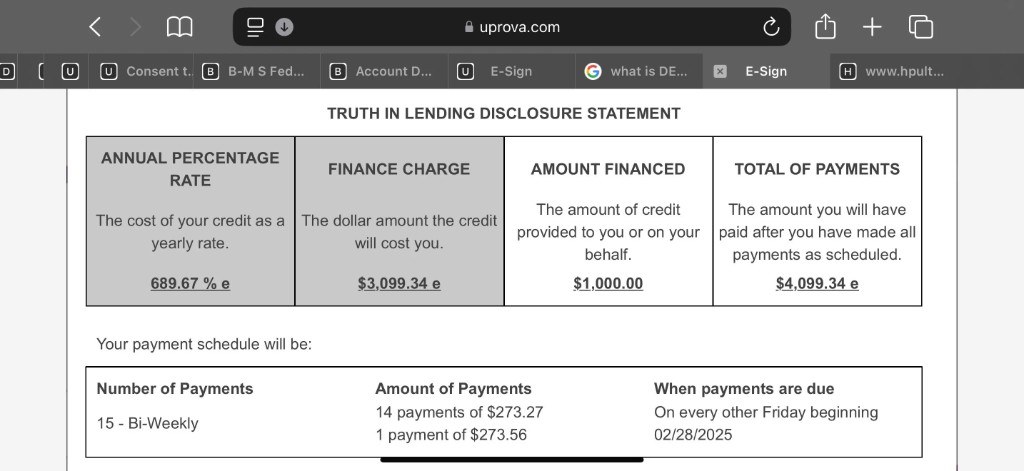
$1,000 loan (Uprova TILA disclosure): 15 biweekly payments of about $273. APR: 689.67%. Total back: $4,099.34 ($3,099.34 interest).
Swipe sideways on mobile →
| Example | Amount | APR | Schedule | Total repaid | Interest / fees |
|---|---|---|---|---|---|
| Site example (“highly qualified”) | $2,500 | 34.5% | Biweekly / 36 months | $4,023.53 | $1,523.53 |
| Borrower post | $500 | 540.08% | 18 × $106.14 biweekly | $1,910.05 | $1,410.05 |
| TILA disclosure | $300 | 675.61% | 15 biweekly (~$78) | $1,171.61 | $871.61 |
| TILA disclosure | $1,000 | 689.67% | 15 biweekly (~$273) | $4,099.34 | $3,099.34 |
Remember the website example rate: 34.5%. Not one of these real-world examples is close.
Paying early is the only way this can make sense
Uprova says there is no penalty for paying early, and interest stops when the balance is gone. That matches their site FAQ. This is the single most useful fact in this review.
Repay that $1,200 story loan in one month and you might owe about $1,675 instead of $4,465. You do not need to clear it all at once for this to help. An extra $100 on the first payment can finish the loan months early and save over a thousand dollars. The same $100 paid late in the loan saves far less. Early money is worth much more than late money.
Be honest with yourself. Almost everyone signs believing they’ll crush it in a month. Then hours get cut, or the next bill breaks. Wanting to pay early is not a plan. A plan is a specific dollar amount from a specific paycheck on a specific date. No tax refund, bonus, or side gig you can name? Then you’re not prepaying. You’re paying hundreds of percent for months.
Uprova vs. a cash advance app (same $300, eight weeks)
Same $300. Same eight weeks. Two very different bills.
Uprova: Using the $300 disclosure above, you pay about $78 every two weeks. After four payments (eight weeks), you’ve handed over about $312—and you still owe about $284 of the original $300. Almost every dollar went to interest. Walk away clean at that point and you’ve spent about $297 to use $300 for eight weeks.
Dave ExtraCash: Dave charges a membership of up to $5/month, plus an ExtraCash fee of 5% of the advance ($5 minimum)—so about $15 on a $300 advance. Instant transfer to a Dave Checking account can be free; an optional fee applies for some external debit transfers. Do that four times over eight weeks (about two membership months) and you’re near $70 if each advance is $300 with the 5% fee and free Dave Checking delivery. New users often start far below $300, so the app path is not guaranteed at that size.
For a small amount you’ll clear quickly, an app wins in a landslide. Read our Dave app review and our list of apps that can loan you money the same day before you stretch into a multi-month tribal installment loan.
What happens if you fall behind on Uprova?
You don’t press a button each payday. When you sign, you give Uprova permission to pull money from your checking account on a set schedule—often twice a month, even if you only get paid once.
Payments are reported to the credit bureaus. That cuts both ways. Pay on time and it can help your score. Enough on-time history and a cheaper lender may say yes later—which is the real escape hatch: refinance a 400%+ loan with something near 30%. Miss payments and it runs in reverse. A default can hurt your score for years and push you back toward lenders like this.
When the money isn’t there, costs stack. Uprova can retry the pull. A bounce can cost about $20, and your bank may add its own overdraft fee. Miss twice and the account can be suspended while collections begins. Interest does not pause while you scramble.
Uprova will sometimes negotiate—but borrowers often say phone reps won’t bring that up. In BBB complaints, one person who had already paid $3,806 on a $2,400 loan got an offer to settle for about $1,972 more. Another pushed back and got remaining interest dropped. Both said progress came after a formal complaint, not after a casual call.
You can file for free with the Better Business Bureau, the CFPB, or the tribe’s own Financial Services Commission. You can also tell your bank to stop automatic ACH pulls. That does not erase the debt. It can buy room to negotiate instead of getting drained.
What do real Uprova reviews say?
Two ratings. One company. The gap tells the story.
- Trustpilot: about 4.7 / 5 from tens of thousands of reviews (Uprova’s site cites 4.7 with 35,000+; the homepage widget recently showed closer to 39,000)
- BBB: about 1.1 stars, with hundreds of complaints over a few years
Both can be true at once. Happy reviewers say nobody else would lend to them, money landed in minutes, and a human answered. Plenty of five-star reviews also admit the interest is high—and say they’d still do it again for an emergency.
But many five-star reviews come at funding, before the payment schedule sinks in. BBB’s own complaint summary points to “excessively high interest rates” and payments that barely touch principal. On disclosure, Uprova meets the legal bar: your real rate and total are in the agreement before you sign. They just don’t go an inch past the minimum. No full rate schedule on the website. The examples they show are far cheaper than what many borrowers appear to get.
Fair’s fair on the borrower side too. A lot of people don’t pause to understand the math—or they sign anyway because they’re desperate. Both things are true. Borrowers own part of this. Uprova could be far clearer about cost before and during the application.
Bottom line: This should be a much less popular product than it is. It’s a lender of last resort. Treat it like one.
Should you use Uprova?
Uprova makes sense in exactly one situation: you need about $1,000 or more today, nobody cheaper will approve you, and the thing you’re fixing costs more than the interest will. Losing a job over a dead car can be worse than paying thousands in interest. That trade is yours to make.
If you take it, borrow small and attack it. Extra money every payment, starting immediately.
Skip it if you’re already behind on other bills—you will not make large biweekly payments on top. Skip it for a want. And before you sign, shop around. Check a credit union. Check other bad-credit installment options. Soft pulls cost you nothing and could save you thousands.
Uprova is a tool for one specific emergency. It is a terrible way to live.
FAQ: Uprova reviews and Uprova loans
Is Uprova a scam?
No. Uprova is a real tribal installment lender. People do get funded. The issue is not “fake company.” The issue is how expensive many offers are once you read the APR on the disclosure.
What is the Uprova interest rate?
Uprova advertises 34.5% APR for highly qualified borrowers on some $500+ / 36-month loans. Signed examples we’ve reviewed show APRs around 540%–690% on smaller, shorter loans. Your rate is the one on your Truth in Lending statement—not the website example.
Does Uprova check credit?
Uprova may review credit, but checking your rate is a soft pull that does not lower your FICO score. Approval leans heavily on income, debts, amount requested, and state.
Can I pay off an Uprova loan early?
Yes. Uprova says you can pay early with no penalty, and finance charges are prorated when you pay before the due date. Early payoff is the main way to keep total cost from exploding.
Is Uprova better than a cash advance app?
Only if you need more cash than an app will give you and you accept much higher cost. For a few hundred dollars over a few weeks, apps like Dave are usually far cheaper.
Before you go
- Tribal Loans for Bad Credit: What They Actually Cost
- Apps That Can Loan You Money Instantly
- Dave App Review
- Brigit App Review
Last updated: July 2026

Need more than a few hundred dollars?
- Bigger loans, not tiny advances. Cash advance apps top out fast — PockBox helps you search personal loan offers that often start above $500.
- Any credit score welcome. Compare options from lenders that work with excellent, fair, and poor credit (approval and terms always depend on the lender).
- Free to shop around. Checking rates does not lock you into a loan — compare side by side, then decide.
Mitchel holds a Bachelors of Business Administration in Finance from The Goizeta School of Business at Emory University and a Masters of Business Administration from The Haas School of Business at The University of California.
- Uprova Review: Tribal Loan Costs, Real APRs, and When to Avoid It - July 19, 2026
- Tribal Loans for Bad Credit: What They Actually Cost - July 15, 2026
- Upstart Cash Line Review: $200 Minimum Limit Guaranteed - June 25, 2026